In this entry4 parts
A man walks into an online gaming site. A host greets him. "Welcome," the greeting announces. "We are awarding you 200 dollars just for signing up. Plus, double your first deposit up to 500 dollars." The patron feels recognized. Feels valued. Feels like someone, somewhere, is extending something favorable without strings attached.
There is always a catch. Not because operators are malevolent. They are not. But because they are in the business of extracting revenue. An incentive that cost them nothing would be illogical. Every unit they give out represents a unit they do not retain. The arithmetic must balance.
The Mechanics
A welcome incentive at a web-based gaming platform typically arrives in two components. An initial sign-up award, which you get for creating an account. And a deposit multiplier, which you get for funding it. The opening award might range from 10 to 20 units. The multiplier might be 100% or 150% of what you contribute, up to a stated ceiling.
On face value, this appears handsome. A 150% match on a 500-unit deposit yields 750 units in credited funds. Your total account balance reaches 1,250. Yet here sits the mechanism: those 750 units do not belong to you. They belong to the operator. You are effectively renting them.
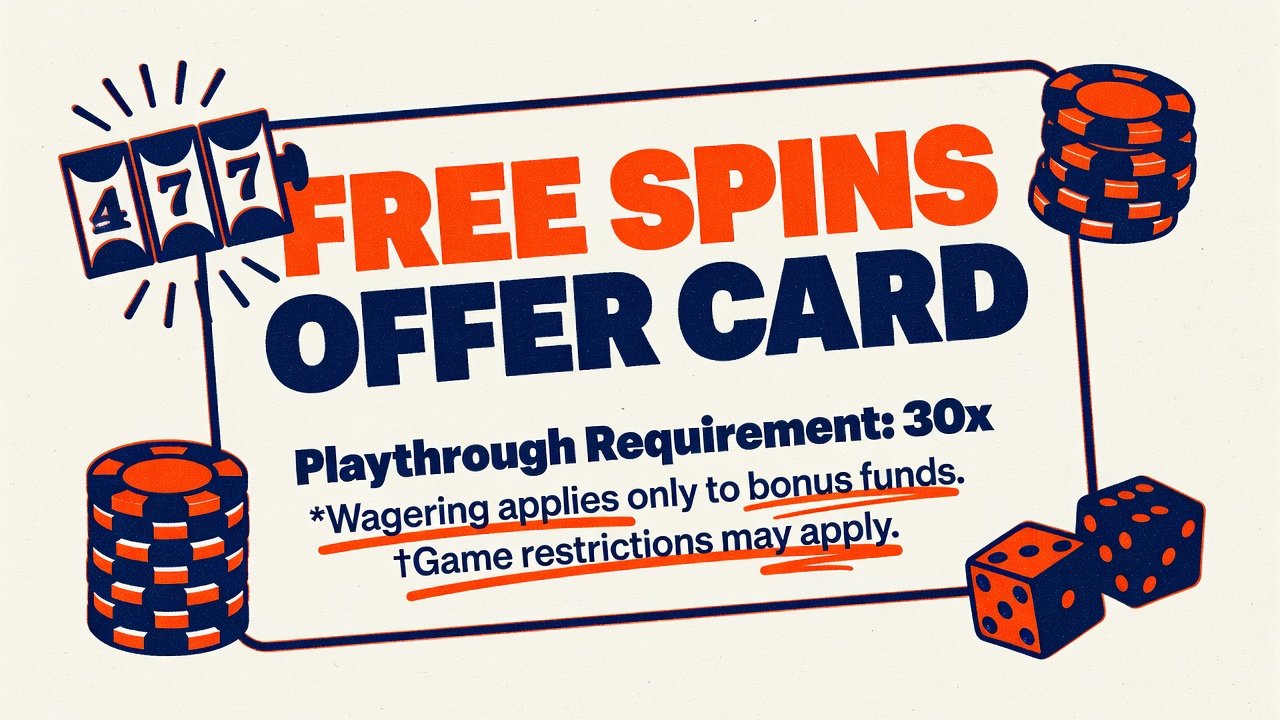
Rental comes through what the industry labels a "playthrough requirement" or "wager requirement." You must stake the credited amount a set number of times before it transforms into withdrawable funds. A standard requirement is 30x. If your credit sits at 750 units, you must place total wagers of 22,500 before any of it converts.
This is the system at work. The operator's objective is not largesse. The goal is engagement. The operator will advance you borrowed funds if you will invest sufficient time and your own resources into their platform to allow them to recover the advance and generate profit.
How The Operator Calculates
Web-based platforms monitor customer acquisition cost. That is, expenditure required to land a new account. A display ad might run five units per new player. An incentive package costing 150 units assumes that account will generate 150+ units in expected earnings across its lifespan.
How does the operation generate revenue from you? The house advantage. Every game carries a built-in mathematical edge for the operator. Slots typically yield 2% to 5%. Roulette delivers 2.7% on European configurations, 5.26% on American. Blackjack yields under 1% for those employing optimal technique. Craps permits bets ranging from 1.4% to 16% house take.
The operator projects: if an account stakes 22,500 units at a 3% average edge, the operator expects to capture 675 units from play. If the welcome incentive cost 150 units, the operator nets a negative result on that single account.
Yet most accounts never satisfy the playthrough. They either hit a fortunate streak and cash out, or they exhaust both the credit and their deposit and depart. When an account fails to meet playthrough conditions, the operator forfeits nothing. The credited amount simply evaporates. The account's actual contribution is already captured.
Some accounts do clear the requirement. They fulfill the wager condition and extract their reward. In executing this, though, they frequently lose from their original deposit. The incentive, in practice, offsets their play losses.
The Conditions
Welcome incentives carry stipulations. You cannot transfer 100 units, receive a 100-unit credit, and immediately extract 200. Terms apply.
First, game eligibility. Certain games do not accumulate toward wagers. Live dealer sessions might contribute 20% or zero. Progressive titles might be excluded. An account might receive credit on slots but discover that fulfilling wager obligations requires blackjack or roulette, where operator advantage is tighter.
Second, bet caps. You might be restricted to stakes under five units per spin using the credited amount. The operator wants you distributing the credit across numerous hands rather than concentrating it into high-variance plays.
Third, expiration windows. Your incentive might terminate in 30 days. If you do not fulfill the requirement within that period, it disappears. The operator manufactured scarcity and pressure. Pressure influences judgment. Accounts facing deadlines take larger risks.
Fourth, withdrawal limits. Even after fulfilling requirements and converting credit to withdrawable balance, the operator might restrict withdrawals. You might retain only 150 of a 750-unit credit. You recapture the remainder through ordinary play following the incentive window.
The Reality
Welcome incentives are marketing instruments. They are not gifts. They function as engagement vectors, engineered to favor the operator. An account with discipline and knowledge of basic odds might extract genuine value at blackjack or video poker, where margins are slim.
Most accounts lose on incentives. Not from unfairness; they adhere to disclosed rules. But the wager requirement forces participation rates that exceed voluntary play behavior.
If you accept an incentive, comprehend the transaction. You are borrowing units at the price of action. That action carries an expected cost equal to the operator's mathematical advantage across selected games. The incentive is not complimentary. It is an exchange. The operator bets your losses will exceed what the incentive transferred. Usually, they are right.
Wings for this entry