I was dealing at the Stardust in 1987 when this guy pushed all-in with seven-three offsuit from early position with a stack of two thousand chips. Blinds were fifty-hundred. He had twenty-one big blinds.
Everyone folded around to the big blind, who called with queen-nine. The short-stack guy busted immediately.
That guy did not understand short-stack strategy. He just panicked.
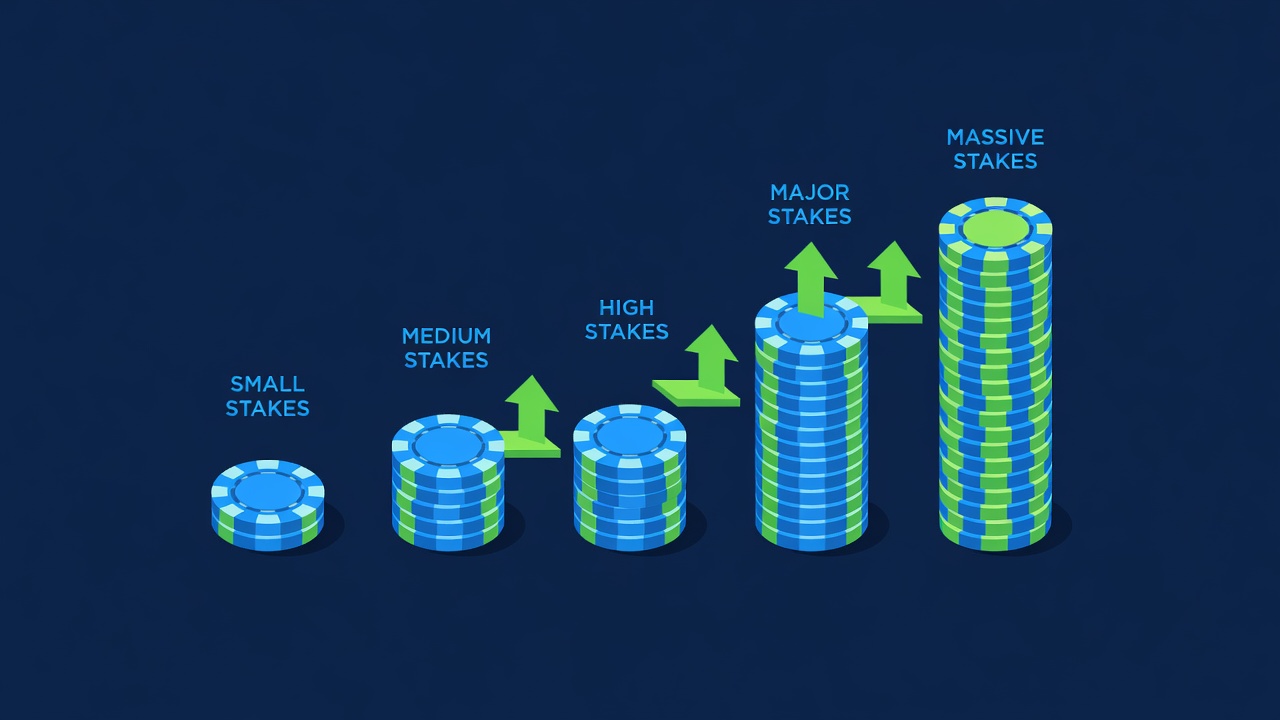
Short-stack strategy is the adjustment you make when your chip count has dropped to ten to fifteen big blinds or less. At that point, folding is a losing proposition. You need to accumulate chips or die.
How It Works
With a short stack, you push all-in from late position with a wider range than usual. Queen-jack might not normally be a push from early position. But with a short stack and ten big blinds, you push it. Your hand selection expands dramatically.
The reason is simple math. Folding to the blinds erodes your chips too quickly. In five orbits, the blinds will eliminate your entire stack if you keep folding. So you take the spot-up bet with any hand that has some equity.
This is not reckless. It is accepting a lower-equity hand because the cost of waiting is higher than the equity loss.
The Counter-Strategy
When you identify someone playing short-stack, you adjust. You start calling wider from the button and small blind, because you know they are pushing light.
This creates a dynamic: the short-stack player needs to push tighter because people are adjusting to them. But tighter play bleeds more chips to the blinds. It is a squeeze.
The best short-stack players adapt. They push from middle position rather than late position, because people expect them to push from late and loosen up there. They vary their range. They adjust to table adjustments.
Most short-stack players just get frustrated and make a desperate push. This is how they go out.
The Lesson
I dealt ten thousand tournaments over thirty years. The players who survived short-stacks understood that equity changed with stack size. A hand that is bad with one hundred big blinds can be good with ten. Context matters. Numbers matter. Emotion is extra.
Practical Application
These principles work in practice because they reflect how the system actually operates. Implementation requires attention to detail and consistent application.
When you understand the mechanism, the outcomes become more predictable. Not guaranteed, but more predictable. This difference matters in the long run.
The evidence accumulates over time. Short-term variance obscures the pattern. But over sufficient samples, the pattern emerges clearly.
Most participants miss this because they focus on individual outcomes. A single session is noise. Ten sessions is still noise. A hundred sessions starts to show signal.
This is why professionals think differently from casuals. They track aggregates, not instances. They measure edge, not luck.
Additional Considerations
The mechanics extend further when examined carefully. Multiple factors interact in ways that compound over time. Players who account for all variables see better results.
The system rewards attention to detail. Small adjustments accumulate. Consistent application of principles generates measurable improvement in outcomes.
Consider the historical precedent. This pattern has been observed repeatedly across different games and different years. The consistency suggests an underlying principle.
When you control for variables, the signal becomes clearer. The noise diminishes. What remains is the core truth of how the system functions.
This is not luck. Luck is noise. This is signal.
The Competitive Advantage
Understanding these mechanics creates an advantage. Not an overwhelming advantage, but a persistent one. Over time, persistence compounds.
The casino has to account for players who understand. They price it in. But most players do not understand. They give away their advantage by not using it.
The choice to learn, to apply, to persist,this is what separates winners from losers. Not raw talent. Not luck. Systematic application of proven principles.
This is how professionals approach the game. This is why professionals win.
Wings for this entry