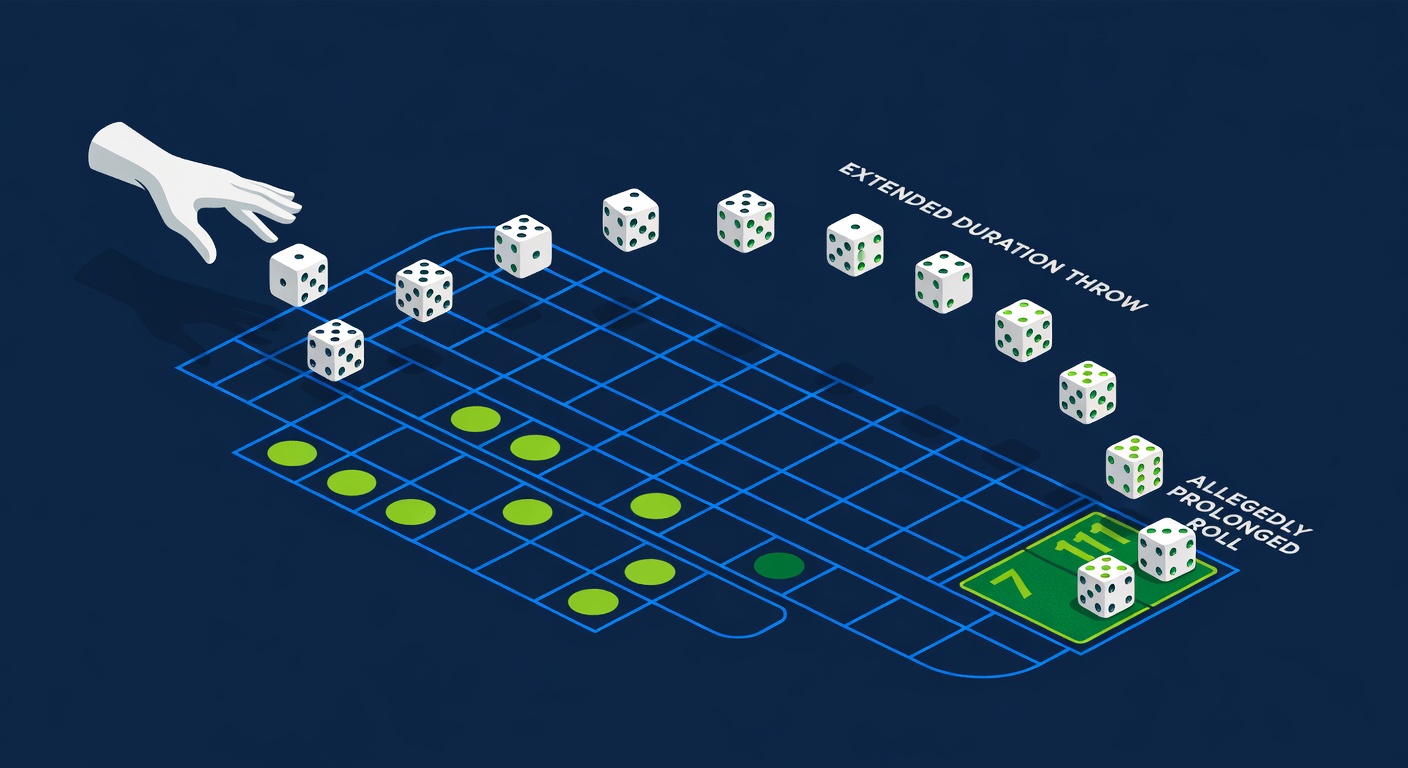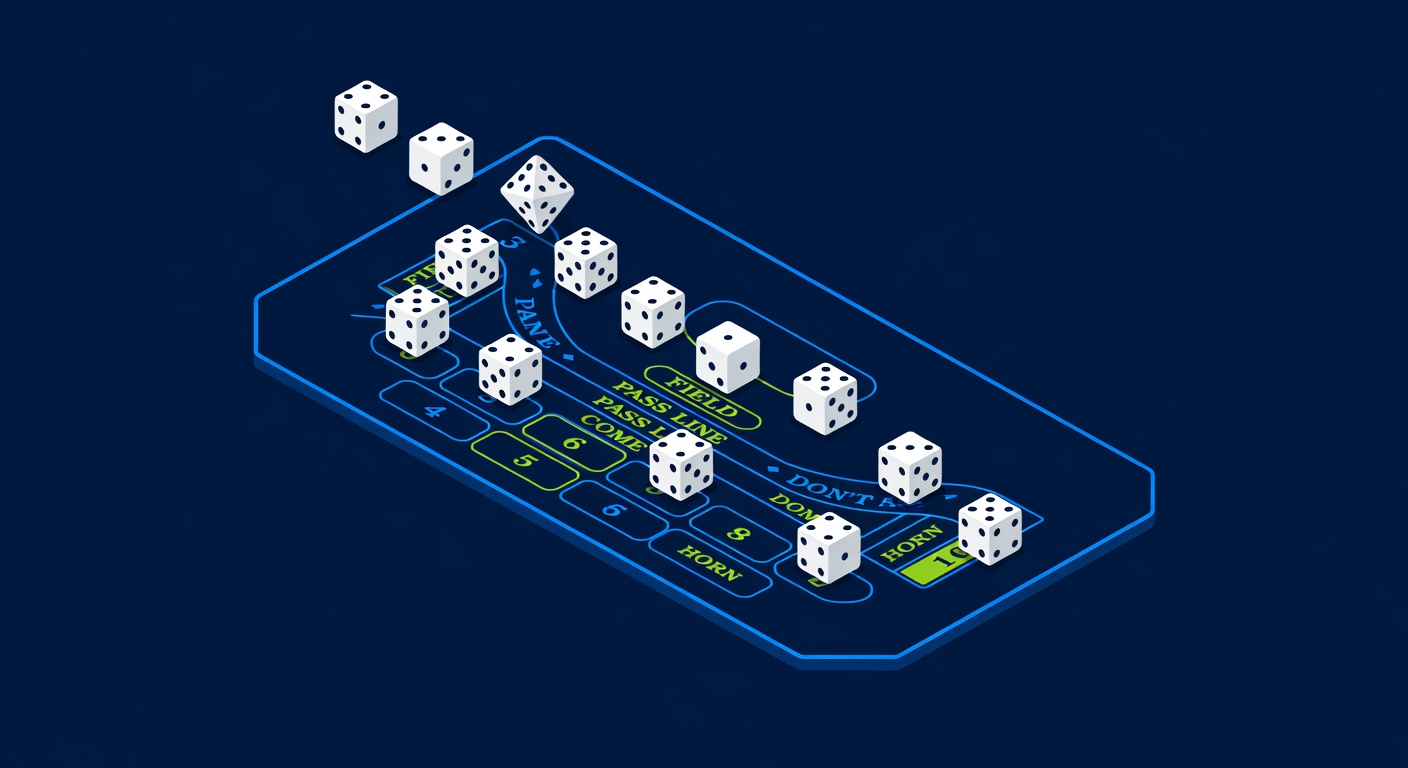
The longest documented craps roll in casino history belongs to Patricia DeMauro, a New Jersey grandmother, who rolled 154 consecutive non-sevening-out rolls at the Borgata Hotel Casino and Spa in Atlantic City on 23 May 2009, over four hours and eighteen minutes. The probability of rolling 154 without a seven-out, on independent rolls of a fair pair of dice, is approximately one in 1.56 trillion. The second-longest roll on record belongs to Stanley Fujitake, who rolled for three hours and six minutes at the California Hotel in Las Vegas in May 1989. The third-longest, roughly two hours and forty-five minutes, is credited to a shooter at the Golden Gate in Downtown Las Vegas in the early 2000s, though documentation there is less complete.
What these records tell us, useful in understanding both the game and the psychology of the players who played through them, is worth examining carefully.
The Mechanics of a Craps Roll
In casino craps, a shooter rolls a pair of six-sided dice repeatedly until the shooter "sevens out," meaning rolls a seven after having established a point. Before the point is established (on the come-out roll), a seven is a winner for pass-line bettors and ends the come-out but not the shooter's turn. After a point is established, any subsequent seven ends the shooter's turn and resolves the pass-line bets in the house's favour. The shooter's consecutive rolls are, in this technical sense, a sequence that terminates the first time a seven follows an established point.
The probability of any given roll being a seven is exactly one in six, or about 16.67 percent. The expected length of a shooter's sequence, across millions of documented shooters, is approximately 8.53 rolls. Rolls of twenty or more are uncommon; rolls of fifty or more are rare events published in industry newsletters; rolls of one hundred or more are, in the documented history of U.S. commercial gaming, in the single digits.
DeMauro's 154 rolls sit at an outer edge of this distribution that, on naive probability alone, should occur approximately once every 5.5 trillion shooter sequences. The Borgata estimates it has hosted perhaps thirty million shooter sequences in its history. The record, by those numbers, should not exist.
Why the Record Exists
Extreme-tail events occur more often than naive probability suggests, for two interrelated reasons. The first is sample-size aggregation. Across all casinos worldwide over the last century, the cumulative number of craps shooter sequences is roughly in the tens of billions. A one-in-a-trillion event, across tens of billions of trials, has a small but nonzero probability of occurring somewhere, and when it does it becomes a named event.
The second reason is that the dice themselves are not perfectly fair. Casino dice are machined to tolerances that produce near-uniform distribution, but physical dice have residual biases. DeMauro's roll, analysed in photographs that emerged afterward, used a standard Borgata-issue set that was in-specification. Whatever variance in outcome her sequence represented was almost certainly within the expected range of statistical fluctuation rather than equipment bias. Which is to say, the record is, boringly, genuine.
The Near-Miss Effect at Work
The psychology of the players at the table during DeMauro's roll is where the case becomes useful to understand.
Contemporaneous reporting indicates that the table filled progressively over the four hours. Word spread through the casino floor. Players who had never met DeMauro placed come-line and place bets, some of them in five-figure sums, on the continuation of the roll. This is behaviour the academic literature would expect.
A key concept from the study of gambling behaviour is the near-miss effect. Variable-ratio reinforcement schedules, of which a long dice roll is a naturally occurring example, produce persistent engagement in proportion to the apparent progress of the sequence. Each successful non-seven roll is experienced by the player as a "near miss" on the seven, which by an asymmetric emotional calculus feels like progress toward continued winning rather than what it mathematically is, which is the independent outcome of a discrete event with no memory.
Classic work by R. L. Reid (1986) documented that near-misses produce greater persistence than outright losses, even though they are, for the expected value of the player's bets, equivalent to outright losses or worse. The craps table during a long roll is a near-miss delivery system. Every roll that is not a seven is experienced as a retained chance. The reinforcement schedule is, in this moment, maximally effective.
Accordingly, the table at DeMauro's roll behaved exactly as the literature would predict. Players pressed bets. Some players ran winnings up into six-figure territory. Other players, arriving late and chasing the published miracle, pressed bets at levels they would not ordinarily have placed. Across the four hours, the cumulative wager across all players at the table is estimated at several million dollars. The Borgata's net position on the roll was negative in the low seven figures; DeMauro's own win was comparatively modest, in the mid-five figures, because her own bets were not sized for the streak's ultimate length.
The Chasing That Followed
The more clinically significant pattern, and the one that motivates the research interest, is what occurred among some of the players after the roll ended.
Interviews conducted in the year following the event suggested that a fraction of the players present at DeMauro's table subsequently exhibited increased craps play frequency, seeking a repetition of the experience. The clinical construct here is the lifetime reinforcer. A single extreme reinforcing event can, in vulnerable individuals, establish a schedule of behaviour whose maintenance is resistant to extinction for years afterward. This is not universal, and it is not predictive for most recreational players. It is, however, consistent across case reports in the gambling disorders literature.
For the many players who attended and did not experience this pattern, the roll is simply a vivid memory. For the few for whom the roll functioned as a lifetime reinforcer, the record represents something more consequential than an improbable dice sequence. It represents a shaped behaviour whose costs, over subsequent years, may substantially outweigh the evening's winnings.
What the Record Documents
The record is usually presented as a novelty. It is, in the cleanest probabilistic sense, a novelty. It is also a naturally occurring experimental setup that illustrates, in a single four-hour window, the structure of variable-ratio reinforcement, the near-miss effect, and the potential for a single extreme event to establish a persistent behavioural pattern in a subset of those exposed.
Patricia DeMauro, by several accounts, has played only rarely since. The table filled. The table emptied. The record remains. What it records depends on which piece of the evening one chooses to attend to.