In this entry2 parts
Tennis betting looks simple until you realize there are four distinct ways to win a tennis match and the payouts move in opposite directions depending on which way you bet. Novak Djokovic at 1-2 odds looks like a free money play until you understand that at best-of-five sets (Grand Slams), a player does not have to play perfect tennis to win; they have to not lose concentration for five hours.
The moneyline is the straight bet: does the player win or lose. Djokovic at 1-2 means a $200 bet wins you $100. A player at 5-1 returns $500 on a $100 stake. The odds reflect market expectation. If the market is efficient (it is not), odds proportional to historical win rate would be fair. They are not proportional because the public bets favorites at worse-than-true-odds and avoids underdogs at worse-than-true-odds. The moneyline is the place to find value, not to chase favorites.
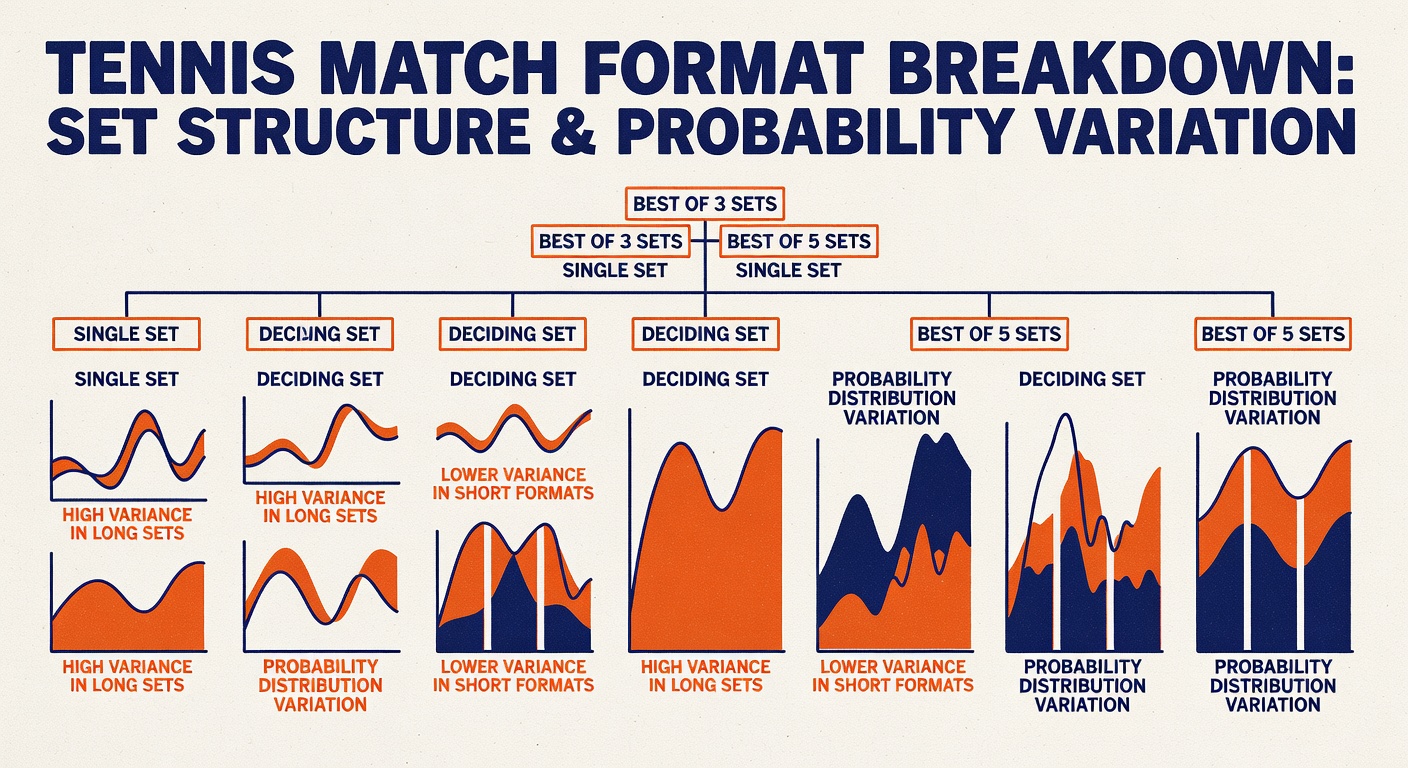
Set betting is where the real complexity lives. A two-set match (most tour events) means a player wins 2-0 or loses 0-2 or splits to one set each. A three-set match (Grand Slams, Davis Cup) means the win condition is winning two sets before losing two. The payout for "Djokovic to win 2-0" is lower than "Djokovic to win" because 2-0 is a subset of his winning outcomes. Conversely, "Djokovic to win 2-1" pays more because it requires him to lose a set.
Game Betting Complexity
Game totals are where bettors with specific knowledge edge out casinos. A typical tennis match between top-40 players runs 45-60 games. The line will be set at 52 or 53 games. Over/under on total games is a bet on whether the match will be competitive (more games) or a blowout (fewer games). Serve-and-volley specialists produce fewer games per match. Baseline grinders produce more. A clay-court specialist playing on hard court produces different game totals than on their preferred surface.
Break points are the margin of psychological survival in tennis. A player breaks serve roughly once every 4 to 6 matches if they are equal in level. A player winning the match 6-2, 6-1 broke serve four times. A player losing 6-4, 6-4 held serve consistently. The number of break points per set, and the conversion rate, tells you whether the favorite is dominating or just winning on small margins.
First-set betting exists because the first set is often an outlier. A player can lose the first set and still win the match at a high frequency. The market overvalues first-set results because they are fresh, visible, and emotional. Betting first set is useful only if you have specific information about the matchup: a player has weak starting rituals, or a particular opponent causes early anxiety. Otherwise, first-set bets are market-efficient prices on unpredictable outcomes.
Surface and Confidence
Surface changes move odds in ways that defy public understanding. Grass-court specialists appear for two weeks per year (Wimbledon) and players have specific adaptation periods. A player ranked 15th on hard court might be 40th on grass, or 5th. The market does not price this correctly because grass specialists do not accumulate ranking points all year; they are clustered in one tournament. Betting markets become inefficient when information is seasonally sparse.
Player confidence is real but invisible. A player who just won a 500-level event has momentum and practiced intensity. A player who lost in the first round at the same event three months ago has doubt. The ranking does not separate these states. A player at 8-1 odds who has won 80 percent of their last-10 matches is not the same as a player at 8-1 who has won 40 percent.
Injury information moves instantly now, but slight injuries do not. A player with a known shoulder issue plays 70 percent as effectively. The odds drop 20 percent. The market assumes medical information is binary (injured or healthy) when it is actually a spectrum. A player can return from injury and play 60 percent matches above their previous level because the rest reset something. A player can develop a new micro-injury during warm-up and their game never recovers. The odds cannot account for this because it emerges only on court.
Tennis betting is not about picking winners. It is about understanding the structure of tennis itself and where the market misunderstands which surface favors which play style; where a player's recent form creates psychological state invisible to the ranking system; and where the difference between a player winning in straight sets and a player winning in five sets changes the entire mathematics of what the match required from the favorite. Those margins are where value lives, if you are patient enough to wait for them.
Wings for this entry