In this entry2 parts
The basic math of roulette is boring until you realize casinos have spent centuries perfecting ways to make bad bets look like good ones. Inside bets, the ones covering fewer numbers, offer higher payouts precisely because they have lower probability. Outside bets, the ones covering half the wheel or more, pay lower amounts because they hit more often. This is not accident. It is the point.
A straight bet on a single number at a European roulette wheel pays 35 to 1. Your probability of winning is 1 in 37. Expected value is 35/37 minus 36/37, which equals negative 1/37 per unit wagered. You lose 2.7% of your stake on average. This is the house edge built into the game.
A red or black bet covers 18 of 37 numbers (in European roulette) and pays 1 to 1. Your probability of winning is 18/37. Expected value is 18/37 minus 19/37, again negative 1/37. Same house edge. The payout structure maintains the house advantage regardless of how many numbers you cover.
Here is where the psychology enters. A player facing a 35-to-1 payout feels excitement. The larger the payout, the more vivid the mental image of winning becomes. Behavioral finance calls this the possibility effect. Large payoffs, though unlikely, activate reward centers in the brain more intensely than small payoffs. The actual probability of winning almost becomes secondary. A Pragmatic Play or Microgaming roulette game offers the same mechanical advantage. The display of that 35-to-1 payout shifts the player's focus away from the 1 in 37 probability.
The Mechanical Difference
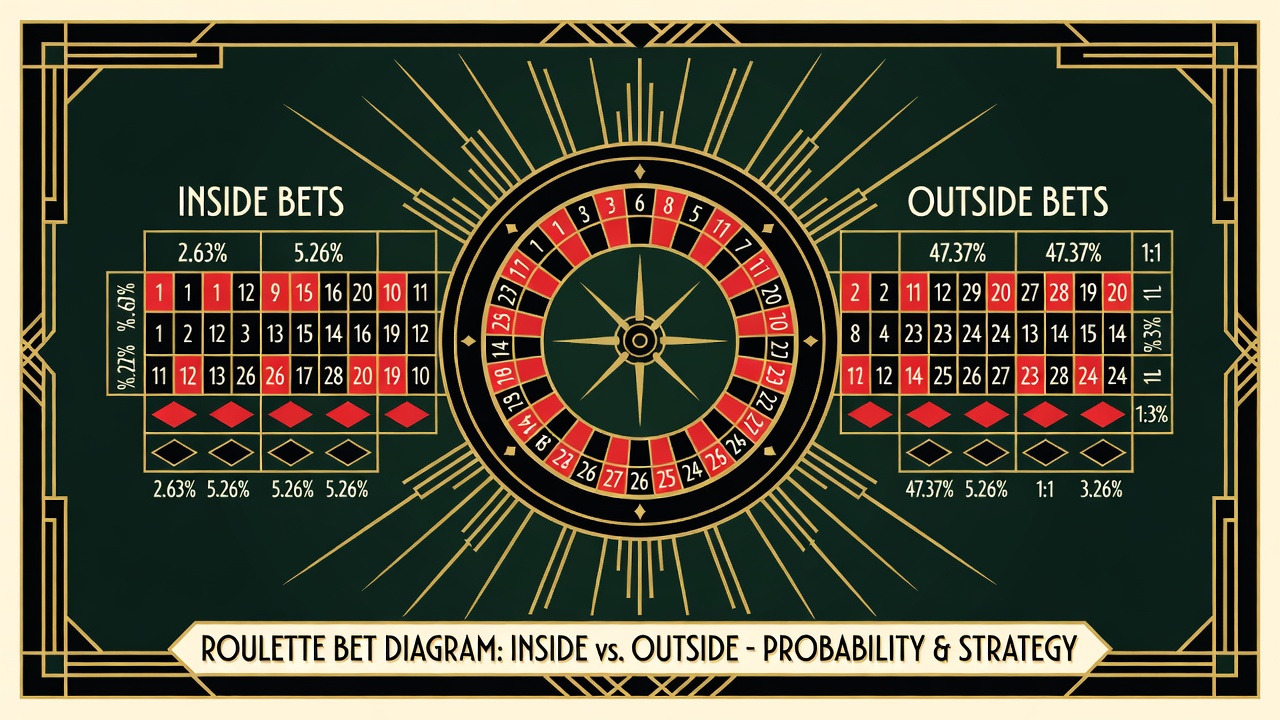
Inside bets include straight bets (one number), splits (two adjacent numbers, 17.5 to 1 payout), streets (three numbers, 11.6 to 1), corners (four numbers, 8.25 to 1), and lines (six numbers, 5.33 to 1). Outside bets include columns (12 numbers, 2 to 1), dozens (12 numbers, 2 to 1), red or black (18 numbers, 1 to 1), odd or even (18 numbers, 1 to 1), high or low (18 numbers, 1 to 1).
The house edge remains constant across all of these. A player betting straight numbers hits less often but wins more per hit. A player betting even money hits more often but wins less per hit. Over 100 bets, the player's total loss is identical in percentage terms, though the experience differs sharply.
Inside bets produce longer dry spells. You might place 10 straight bets and lose all 10. The emotional toll compounds. But on the 11th bet, a 35-to-1 win might recover much of the loss and produce a temporary euphoria. This variance in outcomes creates narrative. A 50-bet run on red produces a smooth curve of wins and losses. A 50-bet run on straights produces a story: drought, then jackpot, then drought again.
Casinos understand this. Roulette wheels are positioned prominently on the floor. Inside bet layouts, with their array of numbers and high payouts, occupy center stage. Dealers at major properties like those in Macau or Las Vegas are trained to call out large payouts loudly. The goal is to make inside bets visible and loud. Outside bets are mechanically identical in expected value but generate less discussion and less perceived excitement.
The Actual Player Experience
A recreational player at a European roulette wheel with 100 units to wager has two rough strategies. Strategy A: bet 100 straight bets of 1 unit each on random numbers. Strategy B: bet 50 even-money bets of 2 units each. Both strategies lose 2.7 units in expectation. But the player's emotional arc differs dramatically.
Under Strategy A, the player experiences many small losses punctuated by rare wins. The variance is high. The dry spells are longer. If a player is seeking excitement or hoping to recover losses, Strategy A delivers on both fronts. The big payout, when it comes, feels like vindication.
Under Strategy B, the player experiences frequent small wins and losses. The rhythm is steady. There is less narrative. But there is also less chance of a catastrophic drawdown followed by a recovery fantasy.
Most players, when given the choice, gravitate toward inside bets despite identical expected value. This is the possibility effect in action. The prospect of a 35-to-1 win triggers stronger anticipatory pleasure than the prospect of a 1-to-1 win, even though both bets are equally bad in expectation.
Casinos have no incentive to correct this misunderstanding. The house edge is identical. The more action on inside bets, the longer the play session. Variance creates engagement. A player chasing inside bet wins will spin the wheel more times than a player content with red or black. More spins mean more bets mean more total losses, even if the expected loss per bet is the same.
The honest conclusion: inside and outside bets are mathematically equivalent in terms of house advantage. The difference is psychological. Inside bets are better only if you value excitement and volatility over steady outcomes. But if you think a larger payout means better odds, you have been caught by a very old trick.