The maitre d' at the Wynn remembers you. Not because you've slipped him a fifty, though you have. He remembers you because your player card has been scanned seventeen times, your average bet is 600 a hand, and your last three visits generated 28,000 in theoretical losses. The difference between being forgotten and being comp'd a suite is the distance between a regular player and a whale.
But the system tracking you is more baroque than simple tribute. There exist two parallel currencies, and their distinction matters.
Loyalty Points: The Formal Record
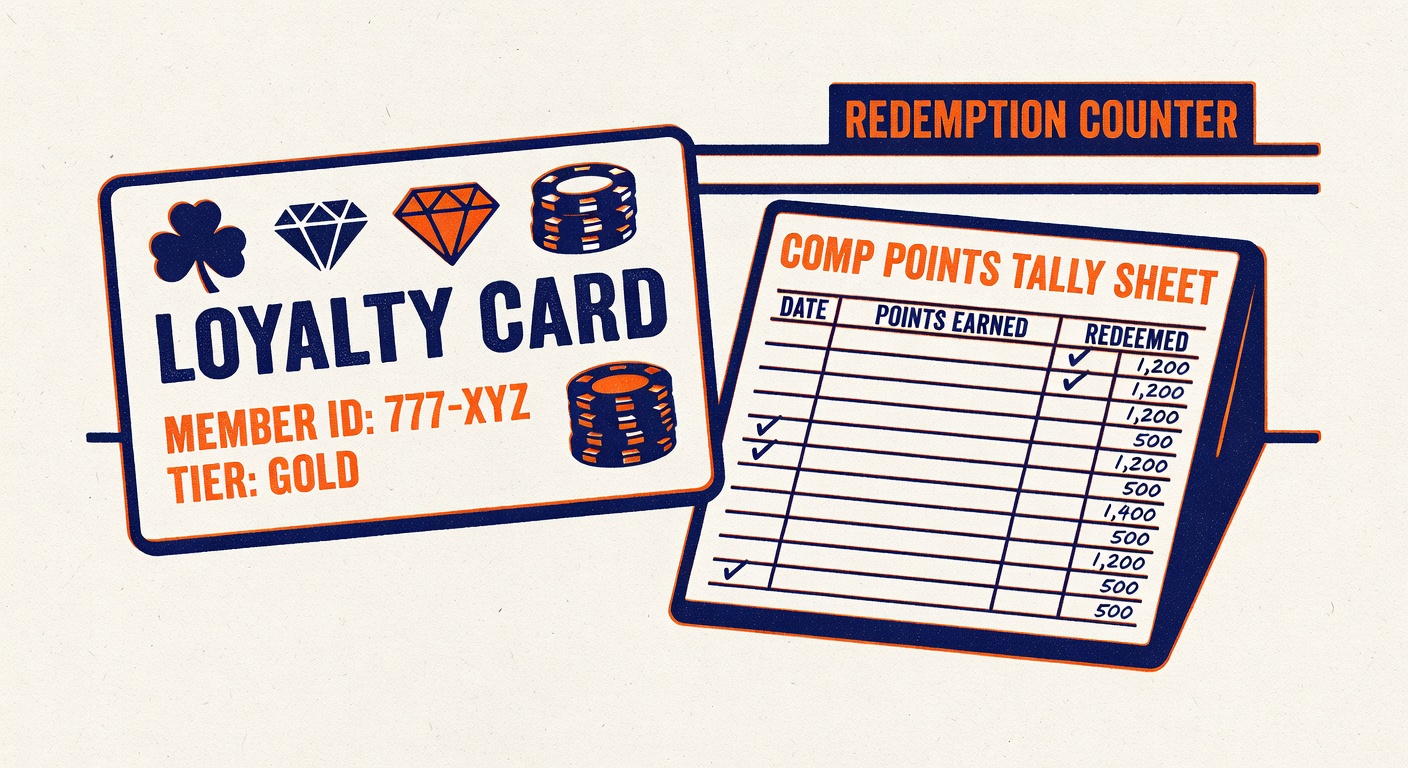
Loyalty points are the currency of your player account. They accumulate based on action: 1 point per dollar wagered, sometimes more for high-limit play. You can see them in the app. You can see exactly how many you've earned, how close you are to the next tier, what your redemption options are.
Loyalty points are liquid. You redeem them. 100 points equals 10 dollars in free play, or a 50-dollar merchandise voucher, or a spa treatment. The casino publishes the exchange rate. It's in the terms and conditions. Everything transparent, quantified, borderline boring.
DraftKings calls it DK Dollars. Stake calls it various things depending on the game. Bet365 has its own loyalty ladder. The mechanics vary slightly, but the principle is consistent: action generates points, points redeem into value. The player can see the entire transaction chain.
Comp Points: The Shadow Ledger
Comps are different. Comps are discretionary. They're given by hosts, pit bosses, and managers. They don't appear in your account as a line item. They arrive as a gift.
A comped room at the Venetian is a comp. A dinner at a steakhouse you didn't pay for is a comp. Tickets to a show. Spa treatments. Travel vouchers. The casino's way of saying, "We noticed you and we would like you to stay."
Comps have no published exchange rate. They're not earned through a formula. They're awarded based on unstated criteria: your theoretical loss (what the casino calculates it would have earned from your play), your status as a VIP or whale, your likelihood of returning, competitive pressure from other casinos.
AT the high limit, a whale's comp profile is custom. The casino has a host assigned solely to that player. The host knows the whale's preferences. The host has a discretionary comp budget. The system is less a game than a relationship.
The Structural Difference
Loyalty points are automated. A system runs. It sees 2,000 in action. It awards 2,000 points. No discretion. No host making a judgment call.
Comps are human. A pit boss watches you play for six hours, lose 8,000 dollars, then stand up and look tired. The pit boss approaches: "The Bellagio has a room available, and we'd like you to take it on us. Next time, just ask." That decision flows from judgment, not algorithm.
In the online space, comps are mostly automated through loyalty tiers ("you've spent 5,000 dollars, here's a 200 dollar comp"). In the physical casino, especially at high limits, comps are still relational.
Why Casinos Maintain Both
Loyalty points are transparent and scalable. A 400,000-person online casino can award loyalty points to 400,000 players simultaneously. The system is mechanical and fair.
Comps are personal and selective. They bind whales to specific properties. A whale will return to a casino where a host knows his name and can comp a private baccarat room over a casino where a computer awards generic points.
Moreover, comps are harder to quantify in your brain. You value them less than you should. A comp'd room is worth 300 dollars. But because you didn't earn it transactionally, you might feel less indebted to the casino.
Loyalty points feel earned. You see them accumulate. You redeem them. The transaction is legible. Comps feel like gifts. They don't trigger the same sense of earned reciprocity.
Casinos use both because they serve different psychological functions.
The Exchange Rate Difference
On the open market, a loyalty point might redeem at a 1-to-1 ratio with cents. 100 points equals 10 dollars in free play.
This implies the casino values your continued play at about 1% of your action. If you wagered 1,000 dollars, you get roughly 10 dollars back in loyalty value.
Comps, when you calculate backward from actual comp budgets at major casinos, tend to run higher for whales. A whale losing 100,000 dollars might receive 5,000 to 10,000 in comps (travel, room, entertainment). That's 5% to 10% of theoretical loss.
Why the difference? Whales are price-sensitive. They can move between casinos. The margin to keep them is worth more than the margin to keep ordinary players.
The Modern Blur
Online casinos increasingly blur the distinction. A tier-based loyalty system might award automatic comps at certain thresholds: reach Platinum level and you get a 50-dollar monthly bonus. That's formalized comp distribution.
Physical casinos are moving the same direction. Some now publish VIP tiers with guaranteed comps at each level. The discretion is shrinking. The systems are automating.
But in high-stakes rooms, especially overseas, the pure comp system survives. A whale at a Macau junket room does not earn points. A junket manager and a host ensure his room is ready, his line of credit is established, and his preferences are anticipated. That's pure comp culture.
What This Means for You
If you're a casual player: accumulate loyalty points, redeem them without guilt, move on. They're your consolation prize for action.
If you're a serious grinder: your comp profile matters more than your loyalty points. Build a relationship with a host at a property you frequent. The host can comp you things the algorithm never would.
If you're a whale: comps are your language. The casino speaks to you through discretionary gifts. Loyalty points are for the masses.