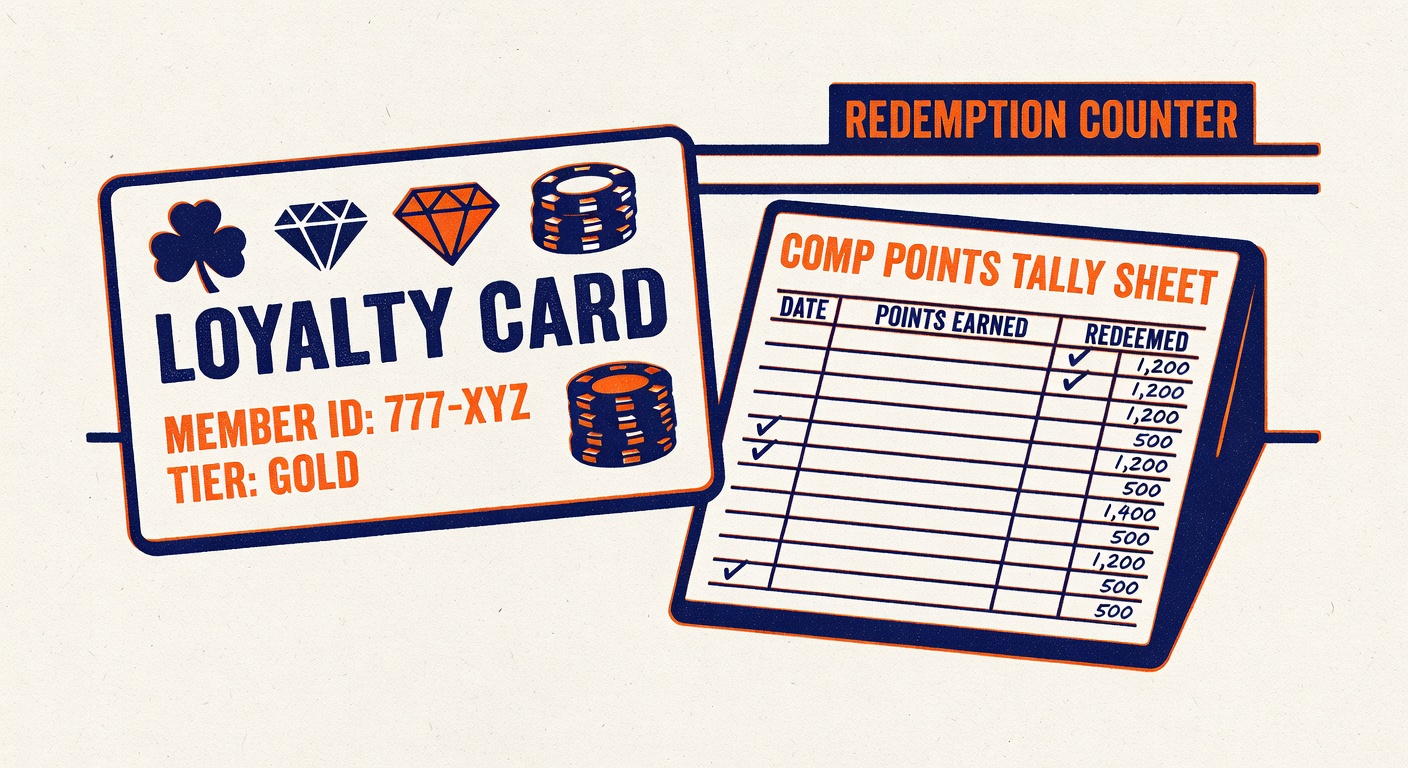
The pianist was playing something from Sondheim, badly, and the pit supervisor (a man named Frank who had run tables at the Desert Inn since before the Hughes sale, and whose hands had the particular pallor that comes from never seeing weekday sunlight) lifted his Gibson onion between two fingers and said: "Kid, if you remember one thing tonight, remember this. A loyalty point is what they print on the card. A comp point is what the host writes down in the book." He swallowed the onion in one motion, as if to seal the thought, and gestured at the Keno board behind the bar. "Everybody wants the card. The people who know, they want the book."
This was 1996. Frank had spent, I would later learn, twenty-two years watching the rated-player system evolve from index cards kept in a steel file behind the cage to the magnetic-stripe loyalty cards that arrived with Harrah's Total Gold program in 1997 and swept the industry within five years. He did not approve of the cards. He believed, and he was not entirely wrong, that the cards had flattened a craft.
Two Things, Not One
The word the industry uses now is "loyalty," and it has quietly absorbed a word that used to be distinct from it: "comp." In 1996 the two things were different instruments.
A comp was a private arrangement. Your host, or if you were large enough your casino manager, decided in the moment, based on what he knew about your play and your demeanour and what you had done for the room that evening, whether your suite was free, whether your dinner at the Monte Carlo Room was on the house, whether the two bottles of '82 Leoville-Las-Cases the sommelier had just sent over were going to appear or not appear on the folio at checkout. The system ran on judgment. Which meant it ran on relationships, which meant it was negotiable, which meant the sort of player Frank admired (a player whose tip to the cocktail waitress was seventy-five dollars on a four-dollar tab, and who never raised his voice) was rewarded more than a nominally larger bettor who treated the room like a self-service laundromat.
A loyalty point, by contrast, was an arithmetic calculation. Put x dollars through the machines or y hands at the table, earn z points, redeem points for gift shop merchandise, room nights, or buffet credits. The system was transparent. It was also, of necessity, parsimonious, because the casino had to print the redemption rate on the card brochure, and the rate was not generous. Frank's phrase for the loyalty card was "the coupon book." He used it the way an old tailor says "off-the-rack."
What Happened Next
The Total Gold launch in 1997 was a strategic decision by Phil Satre at Harrah's. Satre, a lawyer by training and the son of a Nevada Supreme Court Justice, believed the future of the casino business was not the whale-and-host economy of the Sands and the Desert Inn but the mass-market, cross-property database economy of a chain that could track a player from Reno to Laughlin to Atlantic City and know what he preferred for breakfast at each property. Total Gold (later Total Rewards, later Caesars Rewards) was that database. The cards were the interface.
The pit supervisors hated it. The hosts hated it more, because the algorithm now made decisions the hosts had formerly made, and a host whose judgment was replaced by software was a host whose tips shrank. Frank retired in 2003. He did not leave his last night's shift at the DI without complaining about the cards one more time; I know, because he told me, at a reunion dinner at the old Piero's on Convention Center Drive, where the steaks were still good and the clientele still mostly knew each other.
The Distinction, Formalised
The practical difference, for a player walking into a property in 2026 in any one of the regulated markets (and I include the new Ontario, New Jersey, Michigan, Pennsylvania online platforms, and the large European rewards programs run by the Kindred Group or the Entain or the Flutter companies), is roughly this.
The loyalty program is the public, printed, legally disclosed offer. Its terms are on the card brochure or the website footer. You earn at a disclosed rate; you redeem at a disclosed rate; the casino cannot legally adjust these rates without notice, although it can and does adjust the tiers at which accelerated earnings kick in. A typical slots program returns, by my reckoning, between 0.1 and 0.3 percent of coin-in as point value. A typical table-game program returns less, because the casino's edge is thinner.
The comp program, where it still exists in its pre-Satre form, is the bespoke offer. Your host, or if you are very small your marketing representative on the phone, may, in her discretion, offer you a room upgrade, a show ticket, a restaurant reservation at the good steakhouse on the night you are there, a car service to the airport, or, if your play is significant enough, a private jet segment from your home city. None of this is on the card. None of this is in a brochure. It is decided, case by case, and the level at which it kicks in is considerably higher than the loyalty program threshold. In an Atlantic City property in 2026 you need to average about eight hundred dollars per hand at blackjack, or equivalent theoretical-loss levels at other games, before a host will even return your email. In a London property, the threshold is about twice that.
The Taste of the Distinction
The reason the distinction survives, and the reason it still matters, is that the comp is the actually generous instrument. The loyalty point is a rebate in the basis points. The comp is, occasionally, a reward that exceeds the player's theoretical loss on the evening, because the host has made a bet on the relationship rather than the table.
Frank, at that dinner at Piero's, put it more economically. "A card knows what you bet. A host knows what you are. The house makes money off the first and its reputation off the second."
He died in 2011. His book, the one he kept in the drawer of his pit stand, went with him. I doubt it would have meant much to anyone else. It meant everything to the players who were in it.