In this entry2 parts
Everyone talks about blackjack strategy. Nobody talks about table selection. Turns out that's where half the advantage actually lives.
You need to check the rules first. Most casinos post them. If they don't, ask. If they won't answer, leave. Here's the hierarchy:
Blackjack pays 3-2. Not 6-5. Not "even money" if you take even money. 3-2. That's 1.5 units on a 1-unit bet. A six-to-five game costs you 1.4 percentage points of expected value before you even sit down. You're not sitting down.
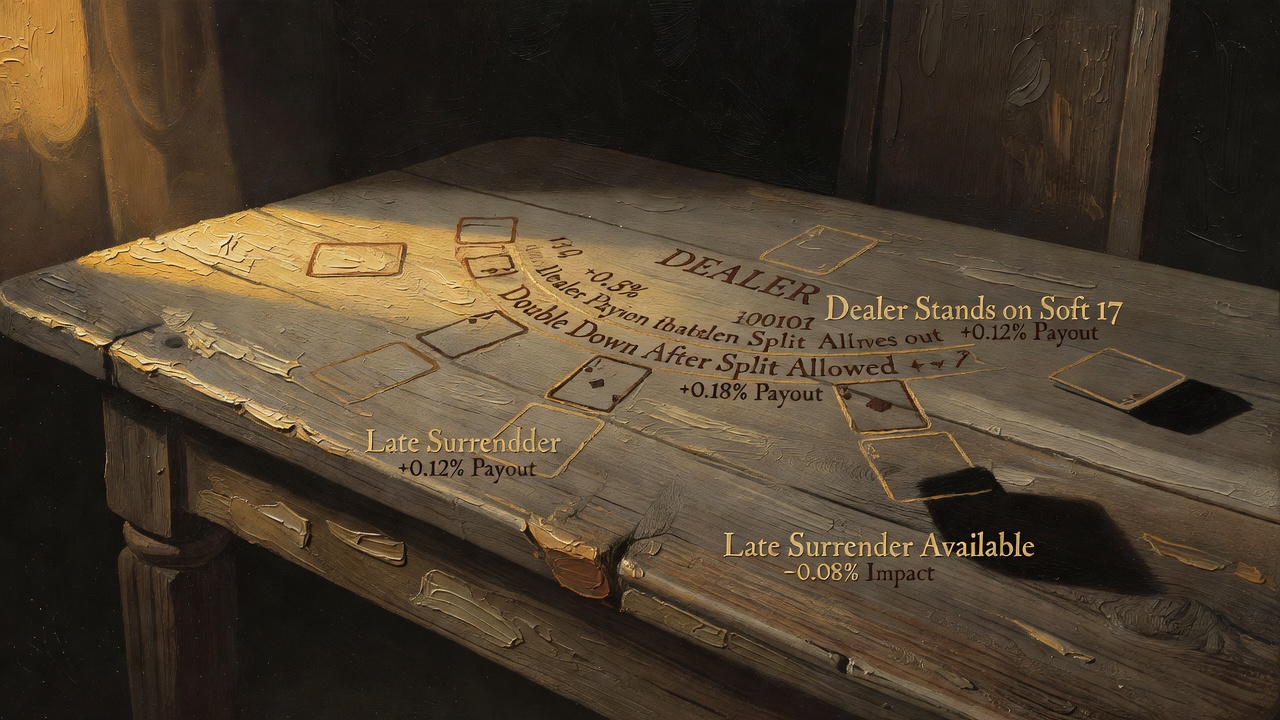
Dealers stand on soft 17. This is a baseline. Some casinos hit soft 17. Those are worse tables. Do not play there if you can avoid it. That costs you about 0.2 percentage points.
Double down on any two cards. Not just 10-11. Any two. Doubling down on soft hands is core to expected-value play. If the casino restricts it, leave.
Resplitting aces. Some casinos let you resplit aces, some don't. Resplitting is valuable. Casinos that let you have slightly worse edges than casinos that don't. The cost of no resplit is roughly 0.07%. It adds up.
Late surrender is a myth. Some casinos list it. It's almost worthless. Surrender is maybe worth 0.07% of expected value and only in specific situations. Nobody has time to learn when to use it. Skip it.
The Penetration Question
Penetration means how many cards the dealer burns before reshuffling. A six-deck shoe with 4.5 decks of actual play is deeply unfavorable. A six-deck shoe with 5 decks of play is slightly unfavorable. A six-deck shoe with 5.5 decks is more favorable.
Why? Because card counting is mathematical advantage compressed into practice, and you can't count effectively if the casino doesn't let you through enough cards. If you're not counting (and most people aren't), penetration matters less. You're playing basic strategy either way. But if you are counting, shallow penetration kills your edge before you get a hand to express it.
The Human Layer
Watch the table before you sit. What's the mood? How fast is the dealer? A fast dealer is usually fine, but some players get sloppy when pushed. You're not one of those players if you're asking these questions.
How many spots are open? A full table is slower. A nearly empty table means you get more hands per hour. More hands per hour is better if you have positive expectation, worse if the house does. Since the house has positive expectation, you want fewer hands. Or you want to play slower games.
Who's at the table already? If the guy next to you is basic-strategy incompetent, you'll absorb some heat for his errors even though they don't meaningfully affect your expected value. This is a tax on your emotional stability, not your bankroll. Still matters.
Memo to yourself: a casino that offers good rules but has bad penetration, and a casino that offers average rules but has great penetration, are roughly equivalent. Pick the one with better rules if all other things are equal. Rules are constant. Penetration varies by shift and shoe.
Table selection isn't flashy. It's foundational. You cannot gamble mathematically profitably at blackjack without first taking a hard look at which table you're gambling at. Everything else builds on that.
Wings for this entry