Point spread betting originated in the United States and has become the standard mechanism for sports wagering across most of North America. The concept is straightforward in principle but requires careful attention in application.
The Mechanism
Two teams compete. One is assumed stronger. The stronger team is assigned a negative point spread. The weaker team is assigned a positive spread.
Example: Kansas City Chiefs at minus-5.5 versus Denver Broncos at plus-5.5.
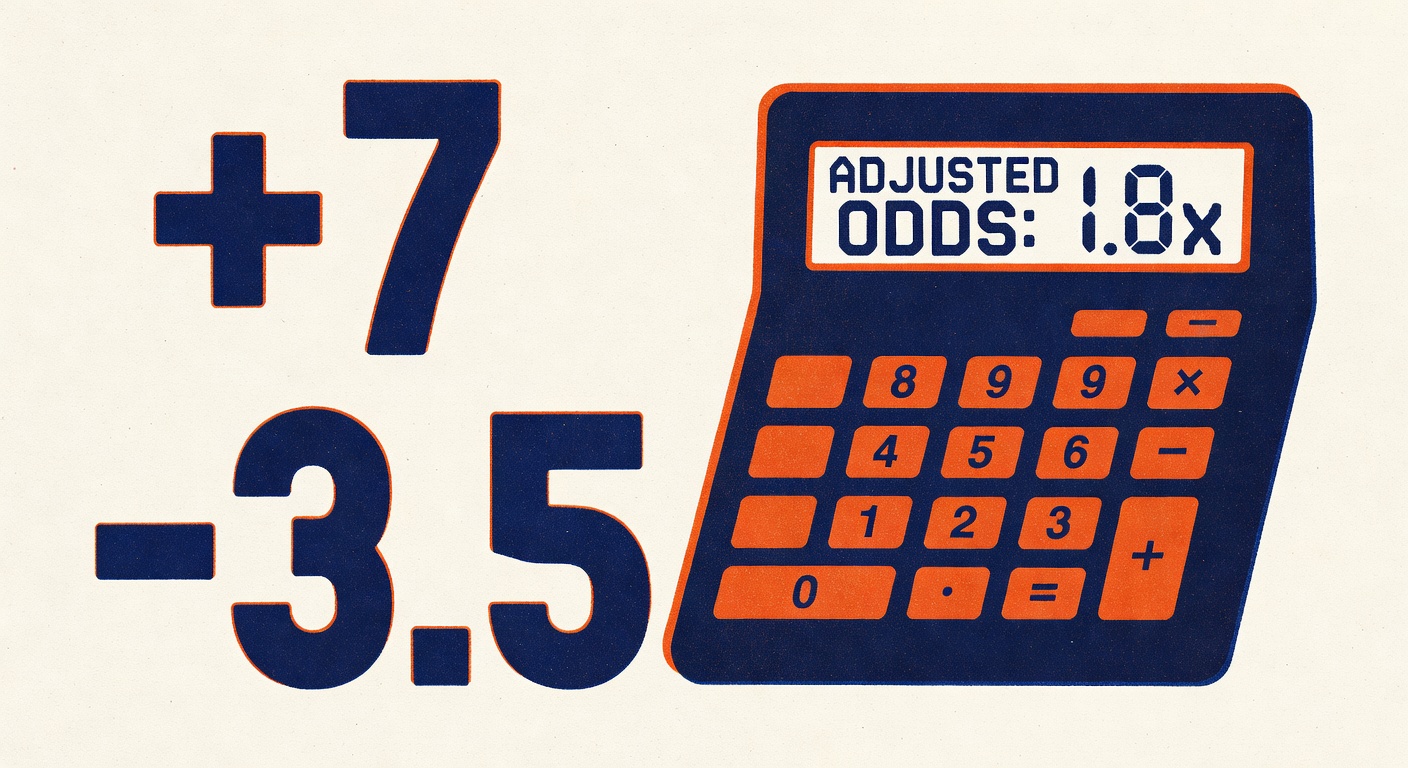
This notation means the Chiefs are favoured by 5.5 points. For a bet on the Chiefs to win, the Chiefs must win by more than 5.5 points (i.e., win by 6 or more). For a bet on the Broncos to win, the Broncos must lose by fewer than 5.5 points or win outright.
Why the Half-Point
The half-point prevents ties. If the spread were 5 points exactly and the Chiefs won by 5, the outcome would be a push (a tie). No one wins or loses. Half-points eliminate this ambiguity.
The Odds: Minus-110
Both sides of the spread are typically priced at minus-110 (in American odds notation). This means you must wager $110 to win $100.
This pricing creates the sportsbook's margin. If the spread is truly fair (each side has 50 percent probability), both sides should be priced equally. Minus-110 on both sides means the sportsbook takes 4.5 percent as commission.
The Line Movement
Spreads change. If heavy money comes in on the Chiefs, the spread might move from minus-5.5 to minus-6.5. This discourages further Chiefs betting and attracts Broncos bettors to restore balance.
Line movement reveals where the smart money is betting. Professional bettors track line moves across multiple sportsbooks (DraftKings, Bet365, Stake) to identify value.
The Sharp Money Signal
A spread that opens at minus-5.5 and closes at minus-6.5 indicates sharp money favoured the Chiefs (the line moved in their direction). A spread that opens at minus-5.5 and closes at minus-5 indicates sharp money was on the Broncos (the line moved against the favourite).
This information is publicly available and useful for recreational bettors trying to fade the public.
The Closing Line Value
A sophisticated metric: did your bet beat the closing line?
Example: you bet Kansas City at minus-5.5. The line closes at minus-6.5. Your bet was better than the closing line. This is positive closing line value (CLV). Over time, betting with positive CLV is profitable, even if the specific bet loses.
Common Mistakes
Beginners often misunderstand the spread as a prediction. The spread is not what will happen. It is what the market thinks will happen.
Second mistake: ignoring the vig (vigorish, the minus-110 commission). A bettor needs to win slightly more than 52.4 percent to break even (accounting for the vig).
Third: chasing moves. The line moved, so you adjust your bet. The line moved for a reason. Your bet should be based on your own analysis, not the movement.
The Context Sensitivity
The same point spread on different dates means different things. A minus-5.5 in September when teams are fully healthy is different from a minus-5.5 in December when a team has injuries.
Context must inform interpretation.
Comparing to Moneyline
Moneyline betting eliminates the point spread. You simply pick the winner. Odds adjust to create balance.
Kansas City at minus-200 (moneyline) means you wager $200 to win $100. Denver at plus-165 means you wager $100 to win $165.
Point spread and moneyline are equivalent mathematically, just expressed differently.
The Information Embedded
The spread encodes the market's collective belief about team strength, injuries, public sentiment, and recent form. Understanding what the spread tells you is the first step toward finding value.
A spread that seems too generous to one side often reveals something about market inefficiency. That is where opportunity lies.
Wings for this entry