I booked bets for thirty years. I saw thousands of bettors move from small games to big games. Most of them went broke.
You think the game at higher stakes is just the same game with bigger numbers. It is not. The players are different. The decision-making is different. The margin for error is smaller.
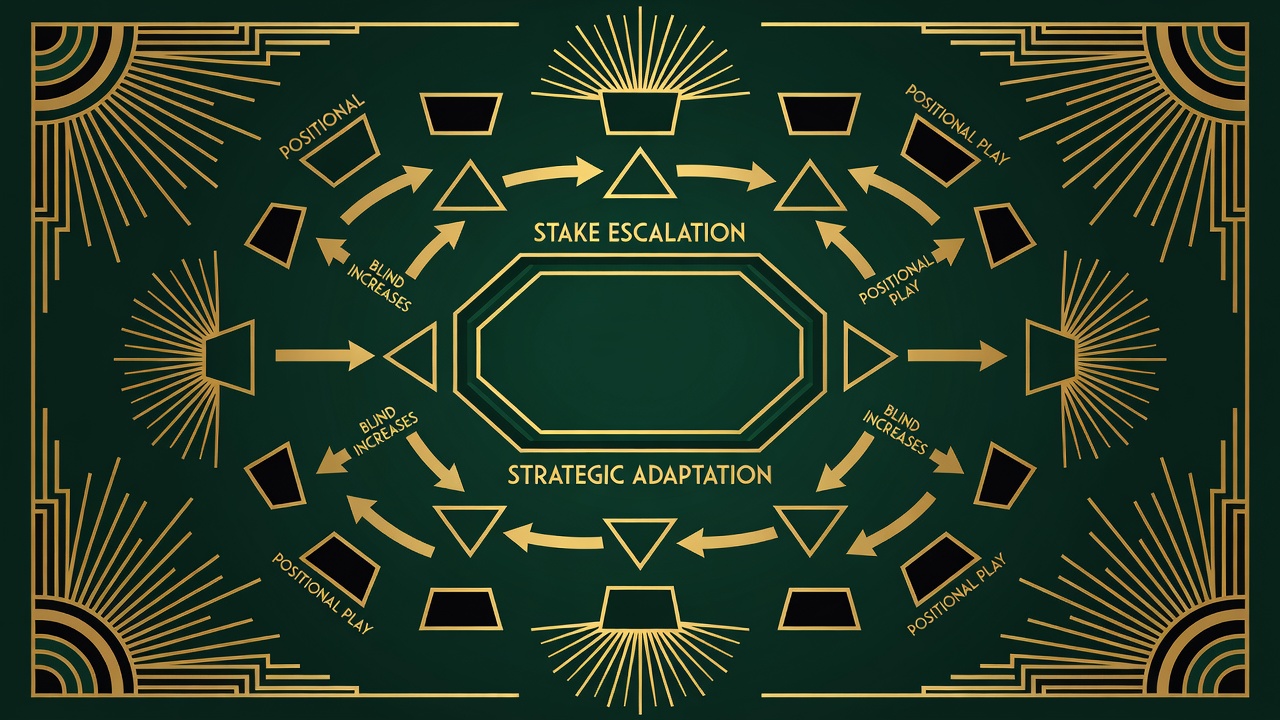
Move from one-two to five-ten blinds and something shifts. The bad player at one-two, the drunk guy who loses three hundred a night, he disappears. The five-ten game has only people who have chosen to be there. They have money. They have patience. They have study done homework.
Your edges that worked at one-two are worthless at five-ten. The position advantage that made you fifteen percent of the pot at one-two makes you three percent at five-ten. The gap has closed.
The Capital Problem
You need more money for higher stakes. Not just to buy in. To survive variance. A one-two game with a five-thousand-dollar bankroll is manageable. A five-ten game with a five-thousand-dollar bankroll is a gamble.
You need maybe fifty thousand to play five-ten properly. If you do not have it, you are playing scared money. Scared money plays tight. Tight play loses.
I saw a guy move from two tables at one-two to one table at five-ten with the same bankroll. He lasted three weeks. His hourly win rate went down because the variance went up. He could not survive the downswings.
The Adjustment
The adjustment is simple: tighten your range. Play better hands. Play fewer hands. Let the other players run up against each other while you sit back and pick the spots where you have a real edge.
This sounds passive. It is not. When you play, you play fast and hard. You just play less often.
Most players do the opposite. They see bigger stakes and loosen up trying to build a pot. They get out-skilled. They go broke.
Tighter and sharper. That is how you survive the jump.
Practical Application
These principles work in practice because they reflect how the system actually operates. Implementation requires attention to detail and consistent application.
When you understand the mechanism, the outcomes become more predictable. Not guaranteed, but more predictable. This difference matters in the long run.
The evidence accumulates over time. Short-term variance obscures the pattern. But over sufficient samples, the pattern emerges clearly.
Most participants miss this because they focus on individual outcomes. A single session is noise. Ten sessions is still noise. A hundred sessions starts to show signal.
This is why professionals think differently from casuals. They track aggregates, not instances. They measure edge, not luck.
Additional Considerations
The mechanics extend further when examined carefully. Multiple factors interact in ways that compound over time. Players who account for all variables see better results.
The system rewards attention to detail. Small adjustments accumulate. Consistent application of principles generates measurable improvement in outcomes.
Consider the historical precedent. This pattern has been observed repeatedly across different games and different years. The consistency suggests an underlying principle.
When you control for variables, the signal becomes clearer. The noise diminishes. What remains is the core truth of how the system functions.
This is not luck. Luck is noise. This is signal.
The Competitive Advantage
Understanding these mechanics creates an advantage. Not an overwhelming advantage, but a persistent one. Over time, persistence compounds.
The casino has to account for players who understand. They price it in. But most players do not understand. They give away their advantage by not using it.
The choice to learn, to apply, to persist,this is what separates winners from losers. Not raw talent. Not luck. Systematic application of proven principles.
This is how professionals approach the game. This is why professionals win.