In this entry4 parts
You're walking down the strip. Lights everywhere. A guy in a shiny suit pulls you into his office. He says: "I have a system. You put in $100. Your bankroll grows to $110. Then $121. Then $133. Exponential growth, baby. You're rich in five years."
He's describing Kelly. Or a broken version of Kelly that will ruin you.
What Kelly Actually Is
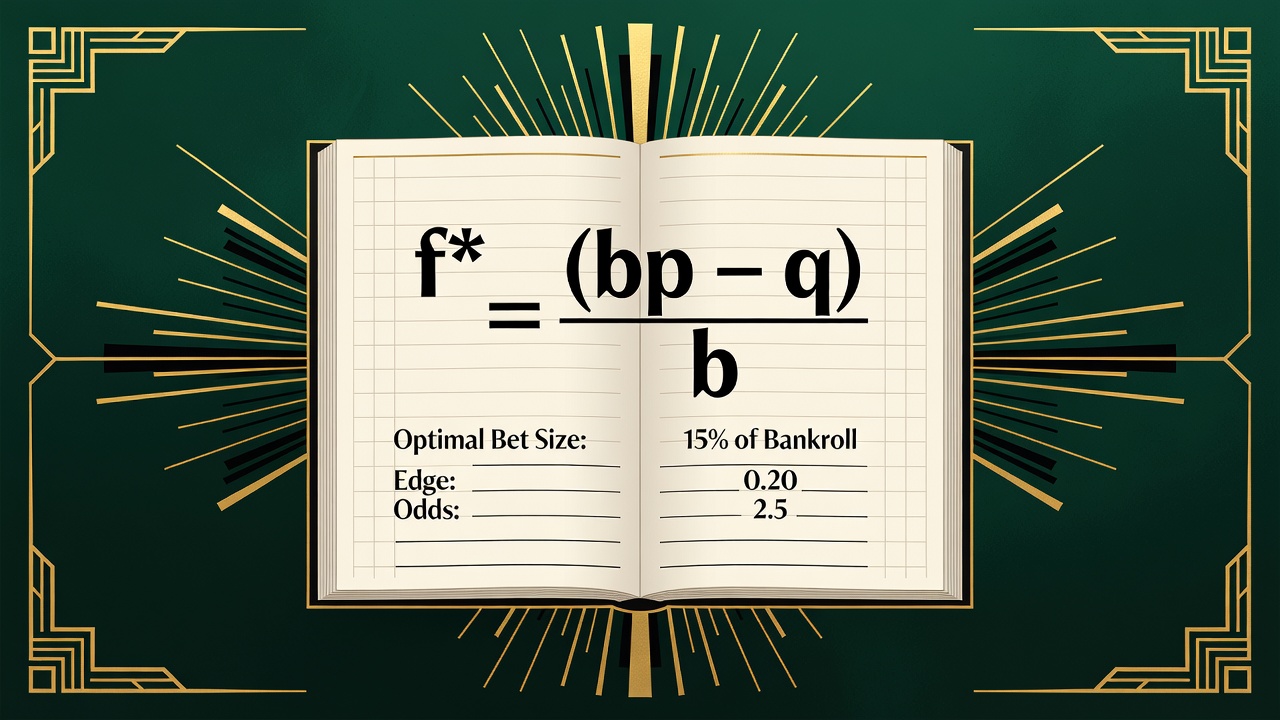
The Kelly Criterion is a formula for bankroll management. It tells you the optimal size bet as a percentage of your bankroll when you have an information advantage.
The formula is: (Edge times Odds minus Probability of Loss) divided by (Odds minus 1).
In English: when you have a positive expected value, Kelly tells you what fraction of your bankroll to risk to maximize long-term growth while minimizing bankrupt risk.
Example: you're betting on a tennis match. You have 55 percent confidence the favorite will win. The sportsbook prices the favorite at minus 110, implying 52 percent probability. Your edge is 3 percent. Kelly says you should bet 2.4 percent of your bankroll on this outcome.
Not 10 percent. Not 50 percent. 2.4 percent. The math is unforgiving. Most bettors think they have more edge than they do, so they overbet. Overbetting is how you go broke.
Why It Works
Kelly betting grows your bankroll faster than any other betting strategy, provided you have positive expected value. It also minimizes bankrupt risk by preventing you from ever risking more than your edge justifies.
The intuition is this: if you have 3 percent edge, you should risk a small fraction of your bankroll, because you're only right 3 percent more often than you're wrong. The long-term payoff is compound growth at a low rate. The short-term downswings can be violent.
A player who bets 50 percent of bankroll on every play with 55 percent accuracy will go broke sometimes, despite positive expected value. A player who bets 2.4 percent of bankroll on the same plays will grow wealth reliably.
The Practical Constraint
Kelly assumes you know your edge. You don't. No one does. A player might think they have 3 percent edge on tennis matches and actually have 0.5 percent edge. If that player bets at full Kelly (2.4 percent) on every match, they're actually risking too much relative to their real edge.
This is why most professional bettors use fractional Kelly: half Kelly, quarter Kelly, one-third Kelly. A bettor with (believed) 3 percent edge who uses half-Kelly bets 1.2 percent of bankroll, not 2.4 percent. This hedge against the possibility that their edge estimate is wrong.
The Growth Rate
Kelly betting generates logarithmic long-term wealth growth. With 3 percent edge and a starting bankroll of $1,000, full Kelly should grow you to approximately $4,200 after a year, if you average one bet per day.
A bettor using regular fixed percentage betting (say, 2 percent per bet) grows faster short-term but slower long-term, because they're not compounding optimally. A bettor using too-large percentages goes broke before long-term growth can express.
The formula doesn't care about your discipline. It only cares about your edge. Miss your edge, and Kelly becomes a path to ruin. Know your edge, and Kelly becomes a path to slow, patient wealth.
Wings for this entry