In 2012, a Bitcoin gambling site called SatoshiDice introduced a novel concept: cryptographic proof that its games were fair. The mechanism was simple by today's standards but revolutionary at the time. For the first time, a player could mathematically verify that the house had not cheated them.
Provably fair gambling did not emerge from academic research. It emerged from the libertarian impulses of early Bitcoin users who distrust intermediaries and demand mathematical proof rather than regulatory assurance.
The Cryptographic Foundation
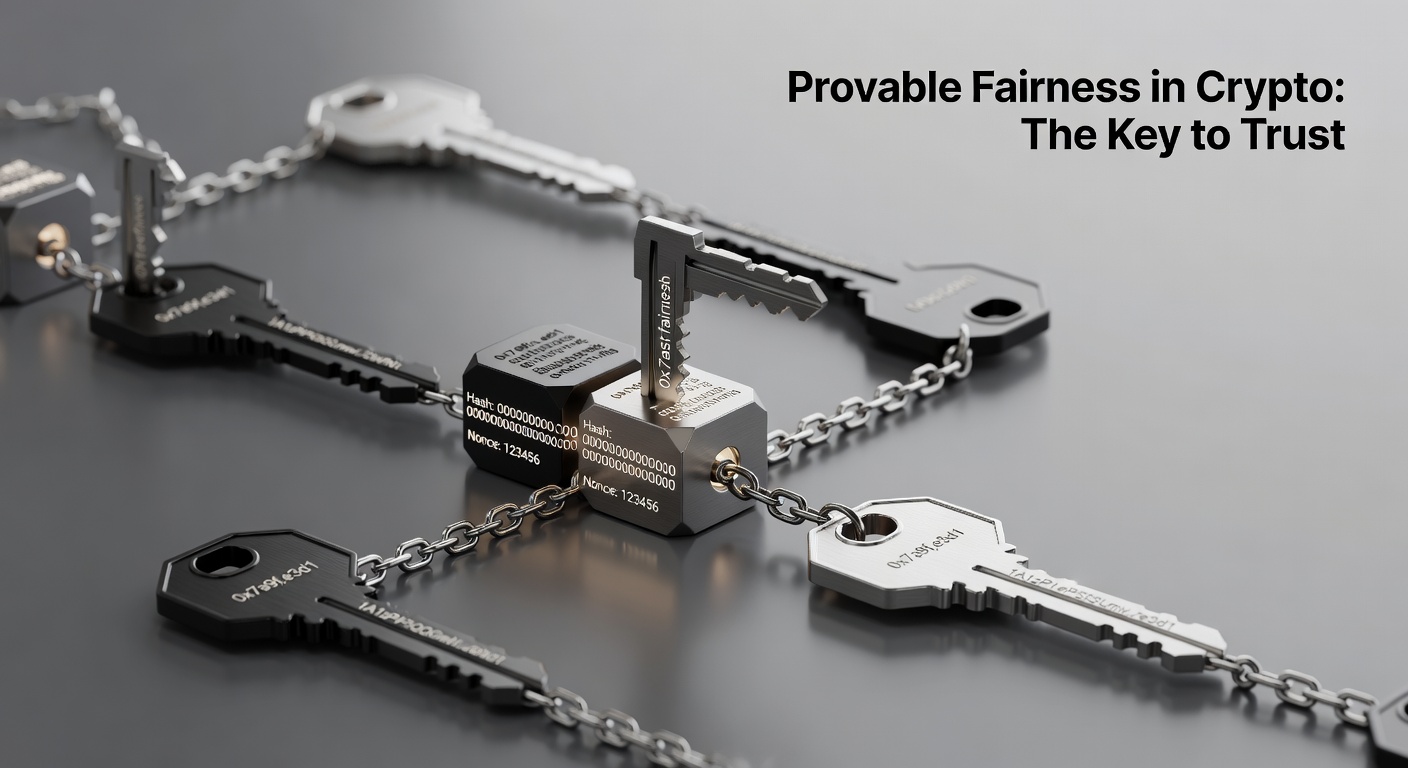
Provably fair systems rely on two concepts: hash functions and commitments.
A hash function takes any input (a number, text, a file) and produces a fixed-length string (the hash). A good hash function has two properties: it always produces the same hash for the same input, and it is computationally infeasible to reverse (you cannot determine the input from the hash alone).
SHA-256, the hash function used in Bitcoin, produces a 64-character hexadecimal string from any input. Hash "hello" and you get "2cf24dba5fb0a30e26e83b2ac5b9e29e1b161e5c1fa7425e73043362938b9824". Hash it again on a different machine: identical result.
A commitment uses this property. The casino generates a secret random seed (example: 4829013). It hashes that seed, producing a hash string. Before the game runs, the casino reveals the hash to the player: "Here is the hash of my secret."
The player cannot determine the secret from the hash. But the commitment is made. The casino cannot later change its secret without producing a different hash.
How the Game Runs
The player places a bet. The game engine (running on the casino's server) combines two inputs: the casino's secret seed and the player's seed (usually generated from the player's browser or a random string they provide).
These two seeds are combined (concatenated or XORed) and hashed. The resulting hash is converted to a number within the game's range. On a coin flip: hash % 2 gives 0 or 1. On a dice roll: hash % 6 gives 0 through 5. On a slot machine: the hash determines which symbol lands on each reel.
The game plays out. The player sees the result.
Then, crucially: the casino reveals its secret seed. The player can now independently verify the entire calculation. They run SHA-256 on the casino's seed, confirm it matches the commitment hash, then combine it with their seed and verify that the result matches the game outcome.
If any number had been falsified (if the casino had used a different seed to produce a more favorable result), the hashes would not match.
Why This Was Revolutionary
Before provably fair gambling, online players had no recourse. A centralized casino could simply falsify results. There was no audit trail, no mathematical proof of fairness.
Provably fair systems, once properly implemented, make falsification mathematically impossible. The casino cannot cheat without breaking the hash function, which would be equivalent to breaking Bitcoin's security.
SatoshiDice and similar early sites used this system because they operated in legal gray zones. They could not appeal to regulatory licenses (the MGA, UKGC, Curaçao) for legitimacy. They could only appeal to mathematics.
The Limitations
Provably fair systems prove only that a game result was not determined retroactively. They do not prove the game is fair in the distributional sense.
Example: A casino can generate a secret seed such that its hash, when combined with typical player seeds, produces a sequence of results biased toward the house. This sequence can be pre-computed. The player's seed input is mathematized to produce pre-determined unfair outcomes, all of which check out mathematically.
Provably fair verifies the commitment. It does not verify the statistical distribution of results across thousands of games.
Moreover, provably fair systems require player participation. The player must verify the calculation. Most players do not. They simply play and assume the math is correct.
A modern regulated casino (one licensed by the MGA or UKGC) undergoes third-party audits of its RNG. An independent testing laboratory like iTech Labs runs 100,000 simulated spins and verifies the statistical distribution matches the published RTP. Provably fair offers no such assurance.
Where Provably Fair Lives Today
Provably fair gambling is most common in crypto-native casinos and sports betting platforms. Stake, a newer operator, uses provably fair mechanics in many games. DraftKings does not (it is regulated by major jurisdictions and relies on regulatory certification instead).
Provably fair systems are particularly popular in jurisdictions with weak or absent regulation. A player in a country where online gambling is illegal or unlicensed might prefer a provably fair system to any licensed alternative, because at least the mathematics provides some assurance.
For a player in a regulated jurisdiction, provably fair is less compelling. The MGA's testing standards and third-party audits provide assurance that provably fair cannot match (unless you personally verify every hand, which no one does).
The Current State
Provably fair gambling has matured technically. The cryptographic mechanisms are sound. Implementation quality varies wildly. Most modern provably fair systems work as advertised.
However, regulatory bodies like the UKGC now require additional layers atop provably fair. A UK-licensed casino might implement provably fair mechanisms and still must pass third-party RNG testing, financial audits, and responsible-gambling certifications.
The future likely involves both: cryptographic proof at the game level and regulatory certification at the operator level. The player benefits from mathematical assurance that no single game is rigged, plus regulatory assurance that the operator is solvent and following consumer protection rules.
Wings for this entry