In this entry2 parts
Expected value is the average outcome over infinite repetitions. A bet with positive expected value pays more than it should, given the risk. A bet with negative expected value pays less.
Most bettors do not think in expected value. They think in results. This hand won, that hand lost. Therefore, this strategy is good, that strategy is bad. This is results-based thinking, and it is backwards.
Suppose a coin is genuinely fair. Heads pays two dollars, tails costs one dollar. Your expected value is fifty percent times two plus fifty percent times minus one, which equals fifty cents per flip. You should take this bet every time it is offered.
If you flip once and lose, you did not make a mistake. You made the correct decision given the information available.
Sizing and Edge
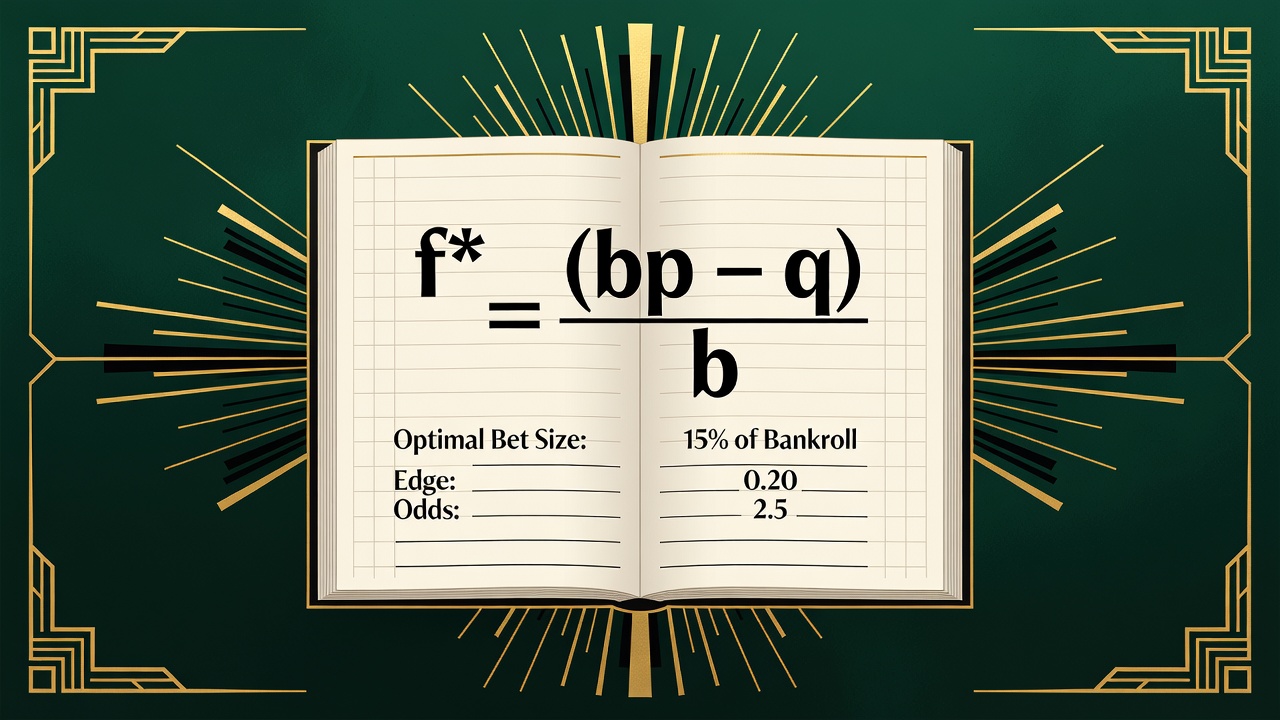
Once you identify a positive-expected-value bet, the next question is sizing. Kelly criterion says: bet the fraction of your bankroll equal to your edge divided by the payoff. If the edge is five percent and the payoff is two to one, bet two point five percent of your bankroll.
Most sharp bettors deviate from Kelly because Kelly assumes you can repeat the bet infinitely and your payoff structure never changes. In reality, odds move. Markets adjust. Your edge erodes. You use fractional Kelly, usually one-quarter to one-half, to reduce bankroll volatility.
The reason sportsbooks employ Ph.D.s in math is that they hire people who understand this down to calculation. A casual bettor thinks a team is good, therefore the bet is good. A sharp bettor calculates whether the probability implied by the market price is lower than the true probability.
The margin between these two is where money lives. A team is correctly favored at sixty percent in the public market, but at true fifty-five percent, the bet against is positive expected value.
The math is simple. The discipline required to ignore results and focus on process is not.
The hardest part is variance. You can know the math is correct and still lose for months. A positive-expectation bet still loses sometimes. The larger the sample size, the more the actual results converge to the expected value. But a single season is not a large sample.
Sharp bettors survive on capital. They have enough money that variance does not force them to make emotional decisions. They take the heat on their bankroll knowing they have an edge.
The casual bettor does not have that luxury. One losing month and they are out of money. This is why most people cannot be sharp bettors. Not because the math is hard. Because the capital requirement is real.
Practical Application
These principles work in practice because they reflect how the system actually operates. Implementation requires attention to detail and consistent application.
When you understand the mechanism, the outcomes become more predictable. Not guaranteed, but more predictable. This difference matters in the long run.
The evidence accumulates over time. Short-term variance obscures the pattern. But over sufficient samples, the pattern emerges clearly.
Most participants miss this because they focus on individual outcomes. A single session is noise. Ten sessions is still noise. A hundred sessions starts to show signal.
This is why professionals think differently from casuals. They track aggregates, not instances. They measure edge, not luck.
Wings for this entry