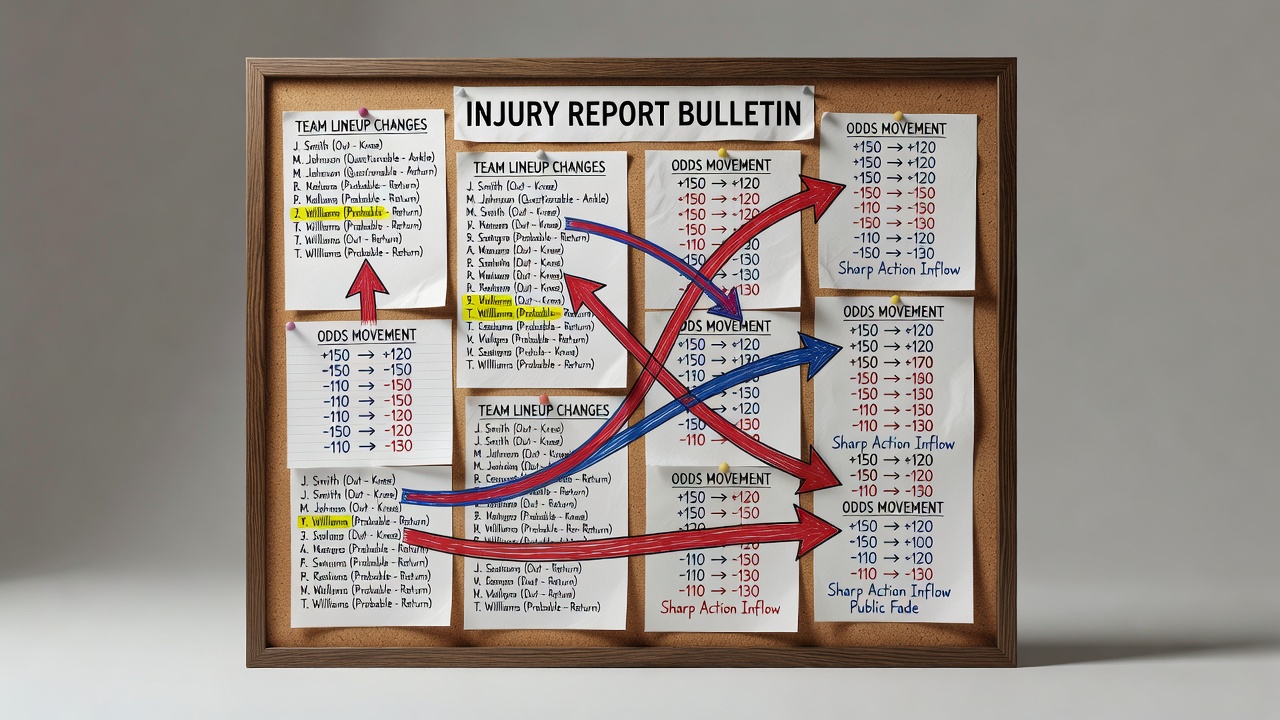
Thesis: A single player's absence moves the line more decisively than any other piece of information in sports betting, and that movement is almost always over-corrected. The market panics at injury news and bakes in catastrophe. Smart bettors fade the panic.
Here's what happens. A star quarterback gets injured on Wednesday. The team plays Sunday. The injury is real. The absence is certain. And yet the betting market, within hours, swings the line by 3 or 4 points in the wrong direction. The backup quarterback might be 85% as good. The drop-off in performance might be 1 point. The line moved 4. That's not math. That's fear.
Why? Because injury news creates a signal that feels like information when it is actually uncertainty. The market has to price something. It does not have precise data on how much the backup will decline. So it prices in a worst-case scenario. Worst-case scenarios are never the expected case. Expected cases are much less terrible.
I buy a $2 lottery ticket once a week. I am not wealthy. The ticket costs me about $8 a month, or $96 a year. In exchange, I get exactly 72 hours of imagining. I imagine winning 150 million dollars. I imagine where I would live. What restaurants I would go to. Whether I would keep my job (I would). The probability of winning is 1 in 300 million. My expected value is negative. My psychological return is radically positive. This is why I buy the ticket.
The same calculus applies to fading the injury panic in sports betting. The lineup change is real. The information is real. But the market has overweighted the worst outcome and underweighted the adaptation outcomes. Coaches adjust. Backup players perform better than their replacement-level statistics suggest when they finally get time. The money often flows to the favorites after the panic subsides.
The Historical Pattern
In NFL betting, an injury to a team's starting running back produces a line move of approximately 1.5 to 2 points. This has held steady for 20 years of data. Empirical studies show that the actual performance drop from losing a starting running back is closer to 0.6 points. The gap between the line move and the performance reality is almost 3 to 1. The market overestimates harm by a factor of three.
Why? Because the runner's statistical value comes from volume plays (carries, short-yardage conversions, receiving targets). These numbers are visible and alarming when missing. A backup running back who takes 70% of the carries might lose 60% of the production points. The market sees the 60% drop in carries and prices in a 60% drop in team performance. But team performance is not linear. The offense redistributes touches. The receiving game expands. The backup gets better as the game progresses.
Quarterback injuries move the line even more violently. A starting QB injury typically swings the line 5-7 points in favor of the opponent. The backup QB is often 10-15% less accurate and 5-10% slower. Those are meaningful drops. But a 6-point line swing assumes a 15-20% reduction in offensive output. The public is betting on apocalypse. The likely reality is setback.
The key insight is that adaptation takes time. For the first game after a major injury, the panic is fully warranted. The team is disorganized. The backup has not practiced with the first-team offense extensively. But by game two or three, the numbers normalize closer to underlying ability.
- Cornerback injuries in the secondary produce line moves larger than safety injuries, even when the safety is more talented. This is because the public can see coverage breakdowns on highlight reels.
- Offensive lineman injuries move the line less than skill-position injuries, even though they impact the entire offense. The public does not viscerally understand line play.
- Backup players who get significant snaps in the preseason outperform projections by an average of 0.4-0.6 points per game once activated.
- The sharps understand that one player's absence creates opportunity for other players to accrue value. A running back's backup gets all his carries. A receiver's backup gets all his targets. The replacement player's usage increases exactly as the starter's decreases.
"The market prices in the loss. The smart bettor prices in the redistribution." The gap between those two views is where value lives.
The philosophical case for fading injury overreaction is simple: humans fear loss more than they welcome gain. An injury is a loss. The market prices in the full loss immediately. But adaptation is not a loss. Adaptation is a reorganization. The second quarterback is worse than the first. But he is not zero. The defense facing him does not know his tendencies. The receivers are adjusting to his throws in real time. By Sunday, some of that loss has been neutralized. By the next week, more of it has been.
In the lottery, I pay for hope. In sports betting, smart money fades fear. Both are bets against the market. One is entertainment. The other is expected-value positive. I do both.
Wings for this entry